
SEO Meta Title
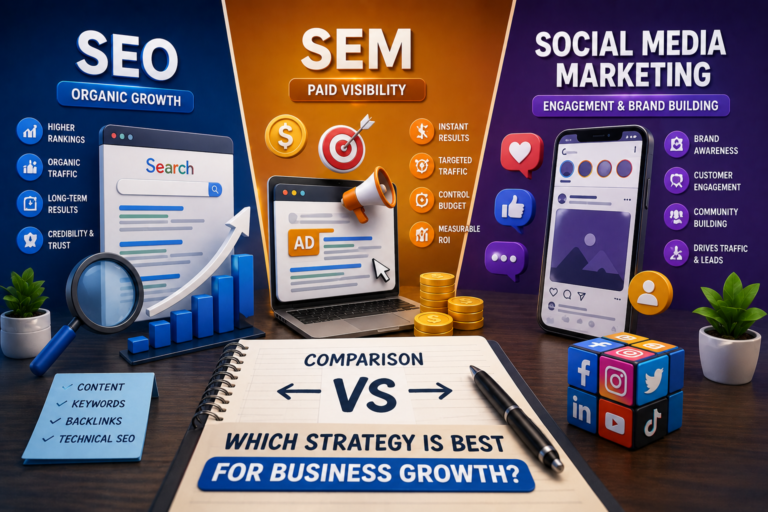
SEO vs. SEM vs. Social Media Marketing: Which Strategy Is Best for Business Growth in 2026?
Meta Description
Confused between SEO, SEM, and Social Media Marketing? Discover the differences, benefits, and best strategies for business growth in 2026 with this comprehensive guide.
URL Slug
seo-vs-sem-vs-social-media-marketing-business-growth
Focus Keyword
SEO vs. SEM vs. Social Media Marketing
Secondary Keywords
SEO, SEM, Social Media Marketing, Digital Marketing, Content Marketing, Google Ranking, Website Development, Web Design, Lead Generation, Online Marketing, Digital Strategy
SEO vs. SEM vs. Social Media Marketing: Which Strategy Is Best for Business Growth?
Introduction
In today’s highly competitive digital landscape, businesses have more opportunities than ever to connect with potential customers online. However, with so many digital marketing channels available, many business owners, entrepreneurs, and marketers often ask the same question:
Should I invest in SEO, SEM, or Social Media Marketing?
The answer isn’t as simple as choosing one over the others. Each strategy serves a unique purpose, offers distinct advantages, and contributes differently to business growth. The most successful businesses understand how these strategies complement one another and use them together to create a well-rounded digital marketing plan.
From my perspective, digital marketing is not about finding a single “best” strategy. Instead, it is about understanding your business goals, identifying your target audience, and selecting the right combination of channels to deliver measurable results. Through my experience working on SEO, SEM, Social Media Marketing, Website Development, Web Design, and Content Creation projects, I have learned that long-term success comes from balancing organic growth, paid advertising, and meaningful customer engagement.
In this article, we’ll compare SEO, SEM, and Social Media Marketing, explore their strengths and limitations, and help you determine which strategy is best suited for your business goals in 2026.
Understanding Digital Marketing Strategies
Before comparing these three approaches, it’s important to understand that they are not competitors. Instead, they are complementary components of a successful digital marketing strategy.
Each strategy focuses on different stages of the customer journey:
- SEO helps people discover your business through organic search results.
- SEM provides immediate visibility through paid advertisements.
- Social Media Marketing builds brand awareness, engagement, and customer relationships.
When integrated effectively, these strategies work together to attract visitors, generate leads, and convert potential customers into loyal clients.
What Is Search Engine Optimization (SEO)?
Search Engine Optimization (SEO) is the process of improving a website’s visibility in organic (non-paid) search engine results. The primary objective of SEO is to help a website rank higher for relevant search queries, making it easier for potential customers to find your business naturally.
SEO focuses on delivering valuable, relevant, and user-friendly content while ensuring that a website meets technical standards required by search engines.
Key Components of SEO
- Keyword research
- On-page optimization
- Technical SEO
- High-quality content creation
- Internal linking
- Backlink building
- Mobile optimization
- Website speed optimization
- Local SEO
- User experience (UX)
Unlike paid advertising, SEO is a long-term investment. While results may take time to appear, the benefits often last much longer and continue to generate organic traffic without paying for every click.
Benefits of SEO
- Sustainable long-term website traffic
- Improved Google rankings
- Increased brand credibility
- Better user experience
- Higher-quality leads
- Cost-effective long-term marketing
- Stronger online authority
Challenges of SEO
- Results take time.
- Requires consistent optimization.
- Search engine algorithms change frequently.
- Competitive industries demand ongoing effort.
From my experience working on SEO projects, I have seen that businesses that consistently publish valuable content, optimize their websites, and prioritize user experience achieve steady improvements in search rankings and organic traffic over time.
SEO is not about achieving overnight success—it is about building a strong digital foundation that delivers lasting results.
What Is Search Engine Marketing (SEM)?
Search Engine Marketing (SEM) involves using paid advertisements to appear prominently on search engine results pages. Businesses bid on relevant keywords so that their ads are displayed when users search for products or services related to their offerings.
SEM is ideal for businesses looking for immediate visibility, quick lead generation, or promoting time-sensitive campaigns.
Key Components of SEM
- Paid search advertising
- Keyword bidding
- Ad copywriting
- Landing page optimization
- Audience targeting
- Budget management
- Conversion tracking
- Campaign optimization
Unlike SEO, SEM can generate traffic almost immediately after launching a campaign. However, traffic usually stops once the advertising budget is exhausted.
Benefits of SEM
- Immediate visibility
- Fast lead generation
- Highly targeted advertising
- Flexible budget control
- Measurable campaign performance
- Excellent for product launches and promotions
Challenges of SEM
- Continuous advertising costs
- Increasing competition for popular keywords
- Requires ongoing optimization
- Poor landing pages can reduce campaign effectiveness
Based on my experience with SEM projects, I have found that paid advertising delivers the best results when supported by a well-optimized website and high-quality landing pages. Even the best advertisements cannot compensate for a poor user experience after visitors click through.
Businesses that combine SEM with SEO often achieve stronger short-term and long-term results than relying on either strategy alone.
What Is Social Media Marketing (SMM)?
Social Media Marketing (SMM) is the process of promoting a business, brand, product, or service through social media platforms such as Facebook, Instagram, LinkedIn, X, YouTube, Pinterest, and other relevant channels. Unlike SEO and SEM, which primarily focus on search engines, Social Media Marketing helps businesses build relationships, increase brand awareness, encourage customer engagement, and create loyal online communities.
In 2026, social media has become much more than a platform for sharing updates. It is now a powerful business tool for storytelling, customer support, lead generation, and community building. Customers expect brands to communicate authentically, respond quickly, and provide valuable content rather than simply promoting products.
From my perspective, Social Media Marketing is about creating conversations instead of advertisements. Businesses that educate, inspire, and genuinely engage with their audience often build stronger relationships and long-term trust than those focusing only on sales.
Key Components of Social Media Marketing
An effective Social Media Marketing strategy includes:
- Content planning and scheduling
- High-quality graphics and videos
- Educational and informative posts
- Community management
- Audience engagement
- Social media advertising
- Influencer collaborations
- Performance analytics
- Brand storytelling
- Consistent publishing
Each platform serves a different purpose. For example:
- LinkedIn is ideal for professional networking, B2B marketing, and thought leadership.
- Instagram focuses on visual storytelling and short-form video content.
- Facebook supports community building and local business engagement.
- YouTube is excellent for long-form educational videos, tutorials, and product demonstrations.
- X is effective for sharing timely updates, industry news, and engaging in conversations.
Choosing the right platform depends on your audience, business objectives, and content strategy.
Benefits of Social Media Marketing
A well-planned social media strategy offers several long-term advantages:
Increased Brand Awareness
Consistent posting helps businesses stay visible and recognizable among their target audience.
Better Customer Engagement
Social media allows businesses to interact directly with customers through comments, messages, polls, and live sessions, creating stronger relationships.
Cost-Effective Marketing
Compared to many traditional advertising methods, social media can be an affordable way to reach a broad audience, especially when supported by organic content and targeted advertising.
Website Traffic
Sharing valuable content with clear calls-to-action can encourage users to visit your website, explore your services, and learn more about your business.
Lead Generation
Strategic campaigns, downloadable resources, webinars, and contact forms can help convert social media users into qualified leads.
Improved Brand Trust
Businesses that consistently provide useful information, respond to customer questions, and maintain transparency often build stronger credibility and loyalty.
Throughout my work on social media projects, I have observed that brands focusing on authenticity and consistency generally achieve better engagement and stronger customer relationships than those posting only promotional content.
Challenges of Social Media Marketing
While Social Media Marketing offers many opportunities, it also comes with challenges:
- Platform algorithms change frequently.
- Building an engaged audience takes time.
- Creating high-quality content consistently requires effort.
- Trends evolve quickly.
- Measuring business impact can be complex without proper analytics.
Success on social media depends on consistency, creativity, and a clear understanding of your audience rather than simply increasing follower numbers.
SEO vs. SEM vs. Social Media Marketing: Understanding the Differences
Although these three strategies often work together, they serve different purposes within a digital marketing plan.
SEO focuses on improving your website’s visibility in organic search results. It is ideal for businesses seeking sustainable, long-term growth and consistent website traffic.
SEM focuses on paid advertising in search engines. It provides immediate visibility and is especially useful for product launches, seasonal campaigns, or businesses that need quick lead generation.
Social Media Marketing focuses on building relationships, increasing brand awareness, encouraging engagement, and nurturing customer loyalty. While it may not always generate immediate sales, it plays a vital role in strengthening brand identity and maintaining long-term customer connections.
Rather than asking which strategy is “best,” businesses should ask which combination of strategies best supports their objectives.
Practical Example: How These Strategies Work Together
Imagine a small business launching a new service.
SEO helps create optimized website pages and informative blog articles so that potential customers can discover the business through Google searches over time.
SEM allows the business to run targeted advertising campaigns immediately after launch, attracting qualified visitors while SEO efforts continue to grow.
Social Media Marketing introduces the new service through engaging posts, videos, customer testimonials, and behind-the-scenes content, encouraging conversations and building trust.
Working together, these strategies create a complete customer journey:
- A customer discovers the business through a Google search (SEO).
- Another customer clicks on a paid advertisement (SEM).
- Someone else learns about the business through an engaging social media post (SMM).
All three channels direct potential customers to the same optimized website, where strong content and excellent user experience increase the likelihood of conversion.
From my experience working on projects involving SEO, SEM, Social Media Marketing, Website Development, and Content Creation, I have found that combining these strategies consistently produces stronger results than relying on any single marketing channel alone.
Which Strategy Is Best for Business Growth?
Comparing SEO, SEM, and Social Media Marketing
When businesses begin investing in digital marketing, one of the most common questions they ask is, “Which strategy will give me the best results?” The truth is that there isn’t a one-size-fits-all answer. SEO, SEM, and Social Media Marketing each play a unique role in helping businesses attract customers, increase brand visibility, and drive growth. Understanding their strengths and how they complement one another is the key to building a successful digital marketing strategy.
Search Engine Optimization (SEO) is a long-term investment that focuses on improving a website’s visibility in organic search results. Businesses that consistently optimize their websites, publish valuable content, and follow SEO best practices gradually improve their Google rankings and attract highly targeted visitors. Although SEO takes time to produce results, it offers sustainable growth and continues generating traffic long after content is published.
Search Engine Marketing (SEM), in contrast, is designed to deliver immediate visibility through paid advertisements. Businesses bid on relevant keywords so their ads appear at the top of search engine results pages. This strategy is particularly effective for launching new products, promoting seasonal offers, or generating leads quickly. SEM provides fast results, but businesses must continue investing in advertising to maintain traffic.
Social Media Marketing (SMM) focuses on creating meaningful relationships with customers through platforms like Facebook, Instagram, LinkedIn, YouTube, and X. Instead of relying on search intent, social media helps businesses build brand awareness, encourage engagement, and create loyal online communities. While it may not always generate immediate conversions, it plays a vital role in influencing purchasing decisions and strengthening customer trust over time.
Which Strategy Is Best for Your Business?
The best strategy depends on your business goals, budget, and timeline.
If your goal is to build long-term online visibility and attract customers through organic search, SEO should be your priority. Businesses that invest in high-quality content, technical optimization, and keyword research often achieve sustainable growth and reduce their dependence on paid advertising.
If you need immediate traffic and quick conversions, SEM is the better option. Paid search campaigns allow businesses to reach potential customers at the exact moment they are searching for relevant products or services. This makes SEM ideal for product launches, limited-time promotions, and businesses entering competitive markets.
If your objective is to increase brand awareness, engage with your audience, and build lasting customer relationships, Social Media Marketing should become an essential part of your strategy. Consistently sharing educational content, responding to customer questions, and creating interactive experiences help businesses develop trust and loyalty.
From my perspective, no single strategy is universally superior. The most successful businesses understand that SEO, SEM, and Social Media Marketing each contribute to different stages of the customer journey. Combining these strategies creates a stronger and more balanced marketing approach.
How SEO, SEM, and Social Media Marketing Work Together
Imagine a customer looking for digital marketing services.
The customer first searches Google and discovers your website through an SEO-optimized blog article. After reading the article, they leave without taking action.
A few days later, the same customer searches again and sees a Google advertisement promoting your services. This SEM campaign reminds them about your business and encourages another website visit.
Later, while browsing LinkedIn or Instagram, the customer comes across one of your educational posts explaining the benefits of SEO and content marketing. The valuable content builds trust and positions you as an industry expert.
Finally, after interacting with your content across multiple platforms, the customer decides to contact your business.
This example illustrates how different digital marketing channels work together. SEO attracts visitors organically, SEM provides immediate visibility, and Social Media Marketing nurtures relationships until potential customers are ready to convert.
Throughout my experience working on projects involving SEO, SEM, Social Media Marketing, Website Development, and Content Creation, I have consistently seen better results when businesses integrate multiple channels rather than relying on a single marketing strategy.
Common Mistakes Businesses Should Avoid
One of the most common mistakes is expecting immediate success from SEO. Many businesses become discouraged because organic growth takes time. However, consistent optimization, valuable content, and patience usually produce long-term results.
Another mistake is depending entirely on paid advertising. Although SEM delivers fast traffic, businesses that neglect SEO often become overly reliant on advertising budgets. Combining paid campaigns with strong organic strategies creates a more sustainable marketing model.
Many companies also use social media only to promote products. Modern audiences prefer educational, entertaining, and informative content over constant sales messages. Businesses that focus on helping their audience generally achieve better engagement and stronger customer loyalty.
Another overlooked issue is poor website performance. Even the best SEO strategy or advertising campaign cannot compensate for a slow, confusing, or outdated website. Website speed, responsive design, clear navigation, and user experience all play critical roles in converting visitors into customers.
Finally, businesses often fail to analyze marketing performance. Tracking website traffic, keyword rankings, conversion rates, click-through rates, and customer engagement allows marketers to make informed decisions and continuously improve campaign performance.
Practical Tips for Long-Term Digital Marketing Success
Based on my experience in SEO, SEM, Social Media Marketing, Website Development, Web Design, and Content Creation, I believe businesses should focus on building a strong digital foundation instead of chasing short-term trends.
Start by creating a professional, fast-loading, and mobile-friendly website. Conduct keyword research before producing content, and publish informative articles that genuinely answer customer questions. Use SEO to improve long-term visibility while supporting important campaigns with targeted SEM advertising. Maintain an active presence on social media by sharing valuable content, engaging with your audience, and building meaningful relationships.
Most importantly, measure your results. Digital marketing is an ongoing process of learning, testing, and improving. Businesses that regularly analyze performance data, adapt to changing market conditions, and continue investing in customer-focused strategies are more likely to achieve sustainable growth.
In my opinion, the future belongs to businesses that successfully combine SEO, SEM, and Social Media Marketing into one integrated digital strategy. Rather than choosing one channel over another, businesses should leverage the strengths of each to attract, engage, and convert customers throughout every stage of their online journey.
Conclusion
Choosing between SEO, SEM, and Social Media Marketing is not about deciding which strategy is universally better—it is about understanding how each one contributes to your business objectives. Every business has different goals, budgets, target audiences, and timelines, so the most effective digital marketing strategy is one that combines the strengths of these channels.
If your goal is sustainable, long-term growth, SEO should form the foundation of your digital marketing efforts. By consistently creating valuable content, optimizing your website, and improving user experience, you can build authority, increase organic traffic, and achieve higher Google rankings over time.
If you need immediate visibility and faster lead generation, SEM provides an excellent opportunity to reach potential customers at the exact moment they are searching for products or services like yours. When managed effectively, paid advertising can deliver measurable results and complement long-term SEO initiatives.
If building brand awareness, customer engagement, and lasting relationships is your priority, Social Media Marketing is indispensable. Social platforms enable businesses to communicate directly with their audience, share valuable insights, showcase expertise, and foster trust through meaningful interactions.
From my experience working on projects involving SEO, SEM, Social Media Marketing, Website Development, Web Design, and Content Creation, I have consistently found that businesses achieve the best results when these strategies work together rather than independently. SEO attracts qualified visitors, SEM accelerates visibility and conversions, while Social Media Marketing keeps audiences engaged and strengthens brand loyalty.
Digital marketing success is not achieved through shortcuts or isolated campaigns. It is built through consistency, continuous learning, data-driven decision-making, and a genuine commitment to delivering value. Businesses that invest in understanding their customers, adapting to market changes, and refining their digital strategies are far more likely to achieve sustainable growth.
As the digital landscape continues to evolve, organizations that remain flexible, customer-focused, and innovative will be best positioned to succeed. Whether you are a startup, freelancer, small business owner, or established enterprise, integrating SEO, SEM, and Social Media Marketing into a unified digital strategy will help you build a stronger online presence and create long-term business success.
Key Takeaways
- SEO is ideal for long-term organic growth and improving search engine rankings.
- SEM delivers immediate traffic and measurable results through paid advertising.
- Social Media Marketing strengthens brand awareness, engagement, and customer loyalty.
- A professional website and high-quality content support all three strategies.
- Combining SEO, SEM, and Social Media Marketing creates a stronger and more balanced digital marketing strategy.
- Data analysis, continuous optimization, and customer-focused content are essential for long-term success.
- Consistency and patience are key to achieving sustainable business growth.
Frequently Asked Questions (FAQ)
1. Which strategy offers the fastest results?
SEM provides the quickest results because paid advertisements can start driving traffic immediately after a campaign launches.
2. Which strategy delivers the best long-term return on investment?
SEO generally offers the strongest long-term return because high-quality, optimized content can continue attracting organic traffic for months or even years.
3. Is Social Media Marketing enough to grow a business?
Social Media Marketing is highly effective for building brand awareness and customer relationships, but combining it with SEO and a well-optimized website usually delivers better long-term results.
4. Can small businesses use all three strategies?
Yes. Even with a limited budget, small businesses can invest in foundational SEO, run carefully targeted SEM campaigns when needed, and maintain a consistent social media presence to maximize their online visibility.
5. Should businesses choose one strategy or combine them?
For most businesses, combining SEO, SEM, and Social Media Marketing creates a more effective and sustainable digital marketing strategy than relying on a single channel.
Call to Action
Digital marketing is no longer about choosing one platform or one strategy—it is about creating an integrated ecosystem that helps customers discover, trust, and choose your business.
Start by strengthening your website, investing in SEO, using SEM strategically for high-impact campaigns, and building genuine relationships through Social Media Marketing. By combining these approaches with valuable content and continuous optimization, you can create a digital presence that supports long-term business growth.
Every successful digital marketing journey begins with a clear strategy, consistent execution, and a commitment to providing value. The best time to invest in your business’s digital future is today.
Suggested Internal Links
- The Importance of Digital Marketing for Business Growth in 2026
- Top Digital Marketing Trends Every Business Should Follow in 2026
- Complete Beginner’s Guide to SEO
- Google Ads and SEM: Best Practices
- Social Media Marketing Strategy for Small Businesses
- Content Marketing That Generates Leads
- Website Development and Web Design Essentials
- Local SEO Checklist for Better Visibility
Suggested Images with Alt Text
Hero Image
Alt Text: “SEO vs SEM vs Social Media Marketing for business growth”
SEO Illustration
Alt Text: “SEO improving website rankings on Google”
SEM Campaign Dashboard
Alt Text: “Google Ads dashboard showing SEM campaign performance”
Social Media Engagement
- Alt Text: “Business engaging customers through social media platforms”
Digital Marketing Strategy
Alt Text: “Integrated SEO, SEM, and Social Media Marketing strategy”
Recommended WordPress Category
Digital Marketing
Suggested Tags
SEO, SEM, Social Media Marketing, Digital Marketing, Google Ranking, Online Marketing, Content Marketing, Lead Generation, Website Development, Web Design, Business Growth, Marketing Strategy, Digital Strategy, Small Business Marketing
Recommended Schema Markup
- Article Schema
- FAQ Schema
- Breadcrumb Schema
- Organization Schema
- Person (Author) Schema
- WebSite Schema
Using these schema types can improve search engine understanding of your content and increase the chances of appearing in rich search results.
Final SEO Checklist
- Focus keyword naturally integrated throughout the article.
- Secondary keywords included without keyword stuffing.
- SEO-friendly title, meta description, and URL slug.
- Clear H1, H2, and H3 heading structure.
- EEAT principles demonstrated through practical experience and insights.
- FAQ section included to improve search visibility.
- Internal linking opportunities identified.
- Mobile-friendly formatting with readable paragraphs and bullet points.
- Strong call-to-action encouraging user engagement.
- Fully optimized and ready for WordPress publishing.
Final Thoughts
SEO, SEM, and Social Media Marketing are not competing strategies—they are complementary pillars of a successful digital marketing ecosystem. Businesses that integrate these approaches, remain customer-focused, and continuously adapt to changing trends will be better equipped to build authority, attract qualified leads, and achieve sustainable business growth in 2026 and beyond.